
What a first Kakobuy Spreadsheet order costs with every default left alone
Kakobuy publishes its fee items in one formula and its optional services in a dozen separate articles. This page puts them on one sheet, and keeps apart the two charges Kakobuy never reconciles.
The fee formula Kakobuy publishes
Kakobuy's help article on calculating purchase fees gives the formula: total cost equals commodity cost plus international freight plus packaging fee plus value-added service fees, the last being optional. Commodity cost is the selling price plus the seller's delivery to the warehouse. There is no agent service fee and no handling fee on purchases.
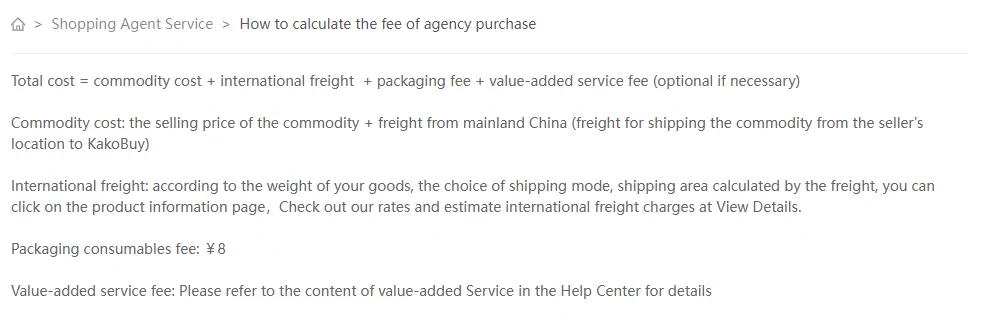
The formula is honest about what it leaves out. Payment handling (the conflicting official PayPal examples of 3.5% or 2.9% plus US$0.30) sits in a different article, and the exchange rate, which can affect the effective cost, is not a line at all. Neither is the shortfall a seller can request after a price change. Read the formula as the floor of what you pay, then add the parts that depend on how you pay and what the seller does.
Two separate ¥8 charges
Article 74 lists a packaging consumables fee of ¥8 per parcel. Article 63 says a customs declaration cost for a parcel is generally RMB 8.00. Kakobuy never says whether these are the same charge described twice, or two charges that both apply. Nothing on the published pages settles it.
This guide therefore keeps the two lines apart and never sums them. If you want the real figure for your parcel, the itemised parcel checkout shows what you are charged before you pay; check it there.
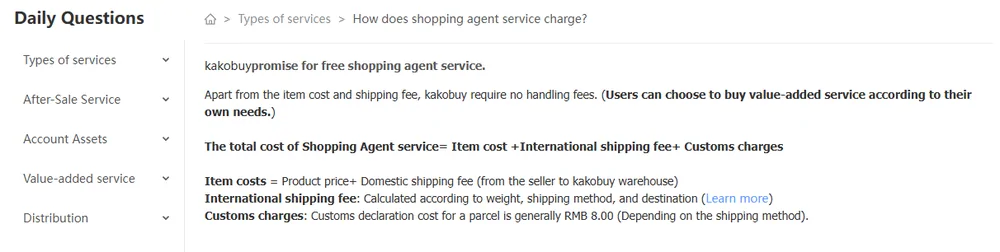
The word generally in the declaration line matters too. It tells you the figure is typical, not fixed, which is one more reason to read the itemised checkout rather than any summary, this one included.
Every optional charge on one sheet
Ten lines, each tied to the decision that switches it on. Value-added prices are in yuan and change from time to time; the storage extension price changed during 2026.
| Service | Price | Decision | Bought when |
|---|---|---|---|
| Priority purchase | ¥5 per commodity order | 3 | Order submission |
| Personalized photograph | ¥2 per photo | 4 | After stock-in |
| Storage extension | ¥10 per order per 30 days | 5 | Before day 100 |
| Pre-packing | ¥18 once | 6 | Before paying freight |
| Parcel photos (three) | Free when ticked | 6 | Parcel submission |
| Vacuum packaging | ¥20 per parcel | 6 | Parcel submission |
| Fragile reinforcement | ¥10 per item | 6 | In storage |
| Kako Insurance | Premium shown at submission | 8 | Parcel submission |
| PayPal top-up handling | Official pages list 3.5% or 2.9% + US$0.30; checkout governs | 2 | Each top-up |
| Alipay / WeChat top-up | No handling charge | 2 | Each top-up |
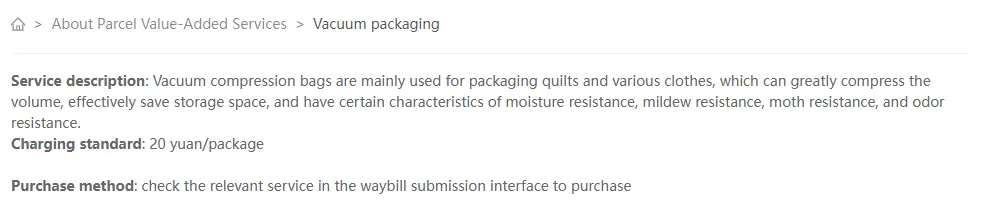
Vacuum bags are the add-on most often bought by reflex. They compress soft goods such as hoodies and quilts, which helps on lines charged by volume and does little on lines charged by actual weight. Check which kind your line is before paying ¥20 for air you were not being charged for.
A worked first order with the defaults
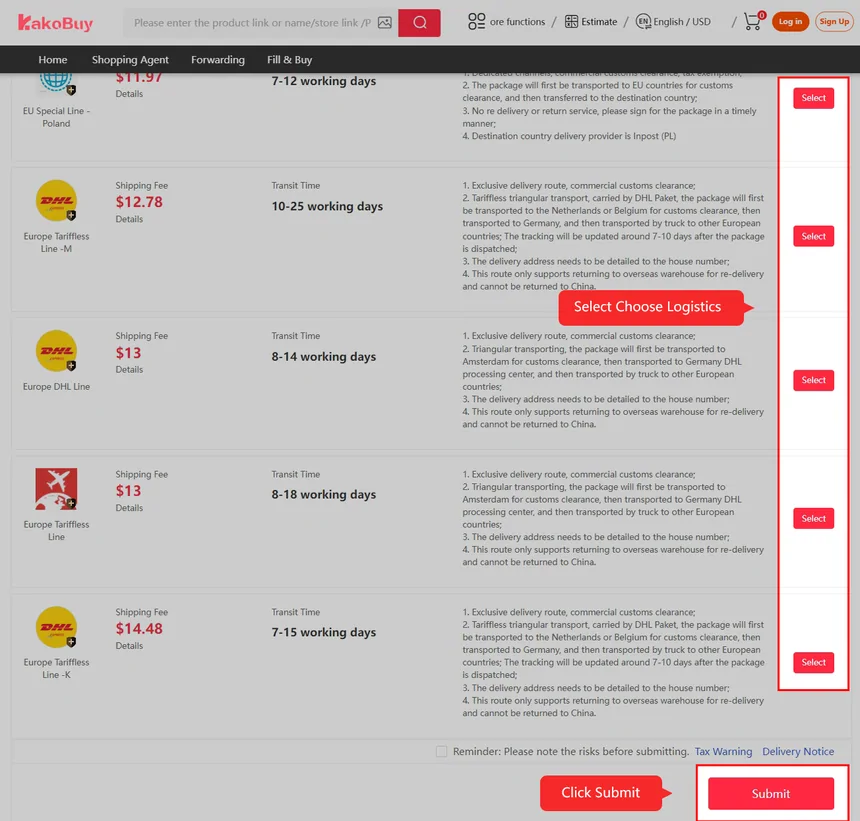
Take three items from three listings, about 1.4 kg packed, shipped to the US, paid with a US$120 PayPal top-up. With nothing switched on, the optional services cost ¥0. The 3.5% + US$0.30 scenario produces US$4.50 in modelled handling; this is an example, not a current fee quote. The published examples mention packaging at ¥8 and declaration generally at ¥8, but do not establish whether both apply. Enter only the separate charges actually shown for this parcel. Freight comes from the estimator for your actual weight and line.
Now switch on the three options first-timers buy most often: priority purchase (¥15 for three orders), three measurement photos (¥6) and pre-packing (¥18). That adds ¥39. An Alipay option described as fee-free in the dated help example removes this modelled PayPal charge, if that option is available; its actual currency conversion still needs comparison. Try your own numbers on the switchboard.
Notice the shape: the optional services are small next to freight. The decisions that move real money are the line (decision 7), the merge (decision 5) and the box size (decision 6), because they act on the biggest number on the bill.
Exchange rate and return fees, the costs inside other costs
A zero service-fee headline does not remove currency conversion costs. Independently measured in October 2026, the all-in markup was about 8.5% over the reference rate. It is not a fixed surcharge to add to every order or evidence of the operator’s margin. Treat that measurement as historical, not as your quote. Compare the amount debited and yuan credited for the payment channel available to you today.
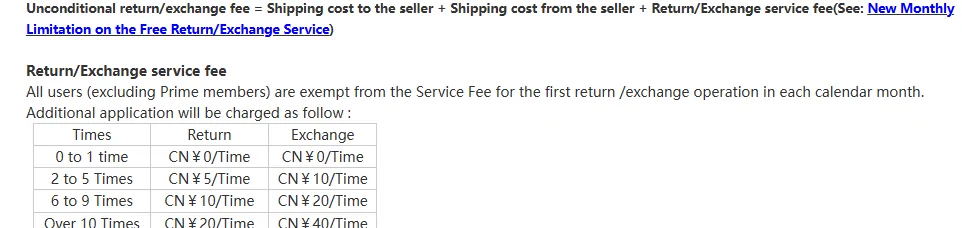
Returns carry three costs: shipping to the seller, shipping back, and a service fee from the second return or exchange in a calendar month. The first each month is described as free of the service fee for eligible non-Prime users; two to five cost ¥5 per return or ¥10 per exchange, rising to ¥20 and ¥40 above ten. For goods with free shipping you pay the return leg; without it, both legs. The published policy describes fee exemptions for eligible wrong items or faults. Ask support which charges apply to your case; return eligibility and reimbursement are conditional.
The shortfall: a charge that arrives after you have paid
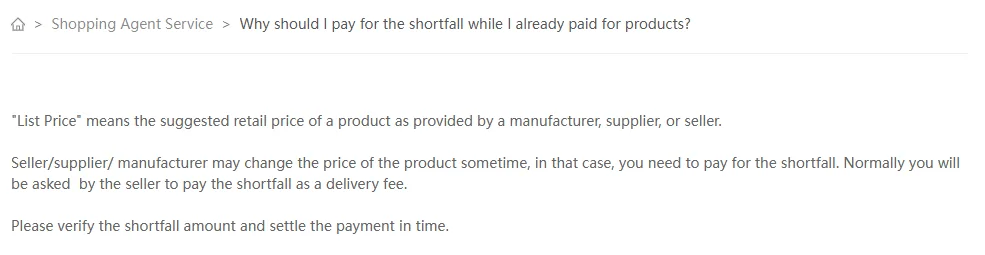
One cost appears in no formula because it depends on the seller. Chinese listings change price, and a seller can also raise the delivery fee once Kakobuy places the order. When that happens Kakobuy asks you to pay the difference, usually presented as a delivery-fee shortfall, and the order waits until you do.
Two habits keep shortfalls small. Order soon after you check a price, because a listing seen a week ago on a catalogue card may already have moved. And leave a little balance after the item payment, so a few yuan of shortfall does not stop the order at the buyer's desk while you top up again.
Put it into practice
Make your own first-order budget
- Keep five separate lines: goods, domestic delivery, payment and conversion costs, international freight, and selected services. Check any destination charges that the quote excludes.
- Use the current itemised checkout to resolve possible overlaps in packaging and declaration charges. Do not add a historical table’s fee twice.
- Compare scenarios using the same currency and exchange-rate date. The switchboard intentionally leaves yuan service totals and dollar processor fees separate.
A seller asks for more money after the first payment
A purchase shortfall and an international freight adjustment are different events. Before approving another debit, identify the commodity order, the reason for the difference and whether the seller has already accepted the purchase. A changed item price, domestic delivery charge and packed shipping weight should not be combined into one unexplained amount.
Compare the new total with the listing and your saved order. If the difference changes your decision, ask what cancellation is still possible at that status; a balance top-up does not itself cancel or amend a purchase. See the link, payment and order-record checks.